Sep 18, 2026Buying Guides
Watch Case Press Guide: Screw and Lever Presses, and How to Choose Die Sizes
How to choose a watch case press and the right die: screw versus lever mechanism, how to measure the case back, and the presses and dies we list.
What actually breaks when a case back is pressed
Press work rarely fails from lack of strength; it fails because of the die. Too small a die puts the load into the middle of the crystal or the centre of the back. Too large a die bites the case edge or the movement ring instead of the seating ring. The result is a cracked crystal, a back seated at an angle, or a bezel that looks flush but is not. Choose the die first.
Screw presses and lever presses
Two mechanisms cover almost everything on a bench.
Type | How it works | Best suited to |
|---|---|---|
Screw press | A top knob drives the ram down thread by thread, so load builds gradually and you can stop anywhere. | Case backs and crystals where the seating ring must take up evenly and a slow squeeze matters more than speed. |
Lever press | A handle drives one firm stroke, with stroke length fixed by design. | Straight flat backs, and repeat work where you want the same stroke every time. |
Both take interchangeable dies; the mechanism is a bench preference. The die decides whether the job goes well.
Choosing the die size
Dies are usually quoted as two numbers: an internal (bore) diameter and an external diameter. The bore sits over the rim you press; the outer diameter is the die body. Dies quoted as 18/20 or 21/23 mm are bore/body pairs.
Measure in this order:
- Take the case off the movement and lay it flat on a bench mat.
- Measure across the seating ring of the case back, the flat face the back lands on, in millimetres.
- For a crystal, measure the crystal opening and note whether it is flat or domed.
- Pick the die whose bore matches that measurement most closely.
- Check the die body clears the lugs and case sides before loading the press.
Four mistakes account for most damage:
- Reading the outer diameter as the working size, leaving a bore that is too wide.
- Forcing an imperial die onto a metric case, or the reverse.
- Using a flat die on a domed crystal, which concentrates load at the apex.
- Pressing with the movement still in place, so a badly seated back reaches the dial side.
If a listing gives one number and no bore/body pair, treat it as approximate and ask first.
Pressing tools we list
Seven items cover our case-press range. Sizes are quoted exactly as each listing states them.
Item | Key specs as listed | Listing |
|---|---|---|
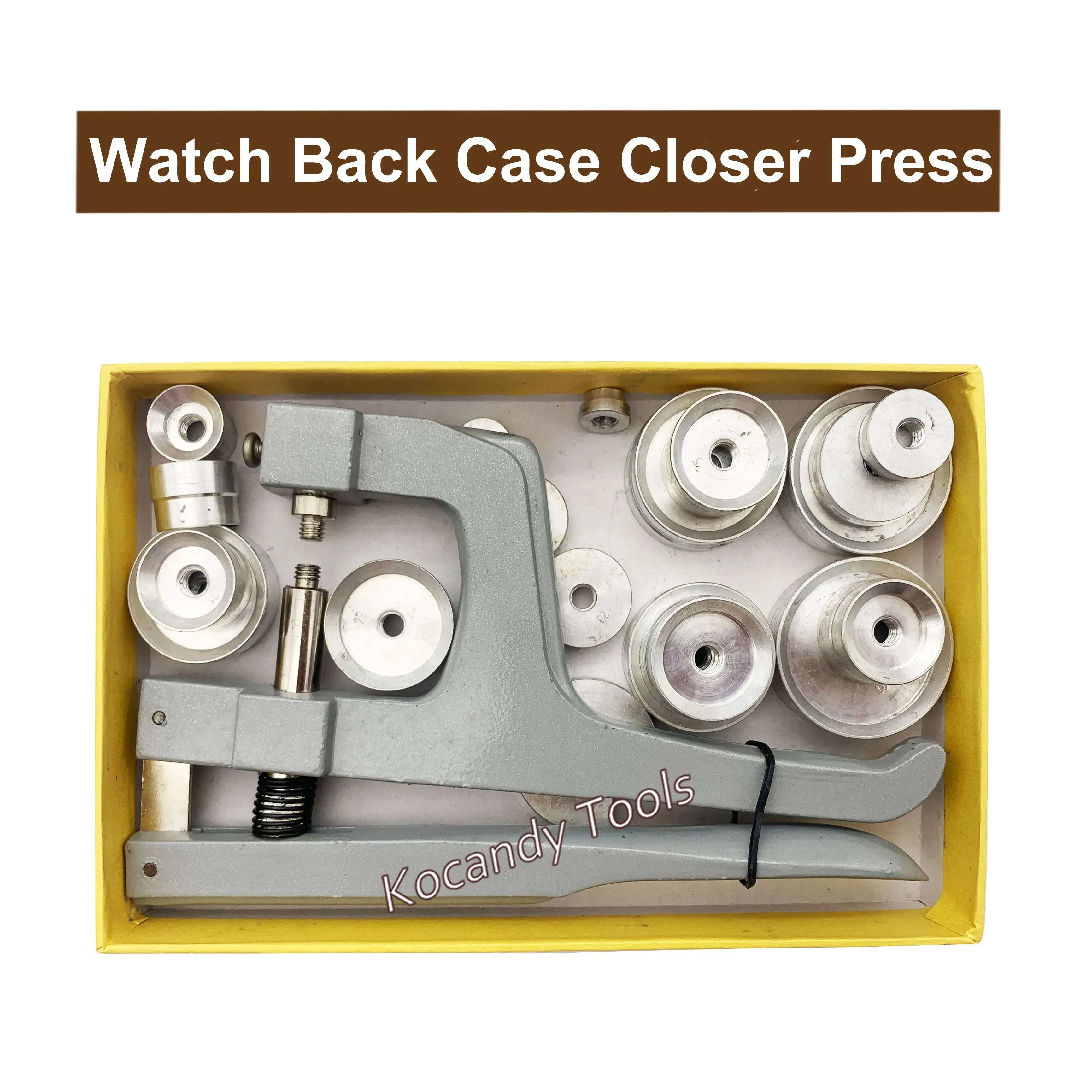
Back case closer press kit, alloy | Stated as 11 aluminium dies for 11 calibers; sizes listed as 17/19/21/23/25/27 mm | |
Back closer press set, 12 dies | Stainless steel; model SP0000039; 12 dies; one die listed at 15-17 mm / 0.59-0.67 inch | |
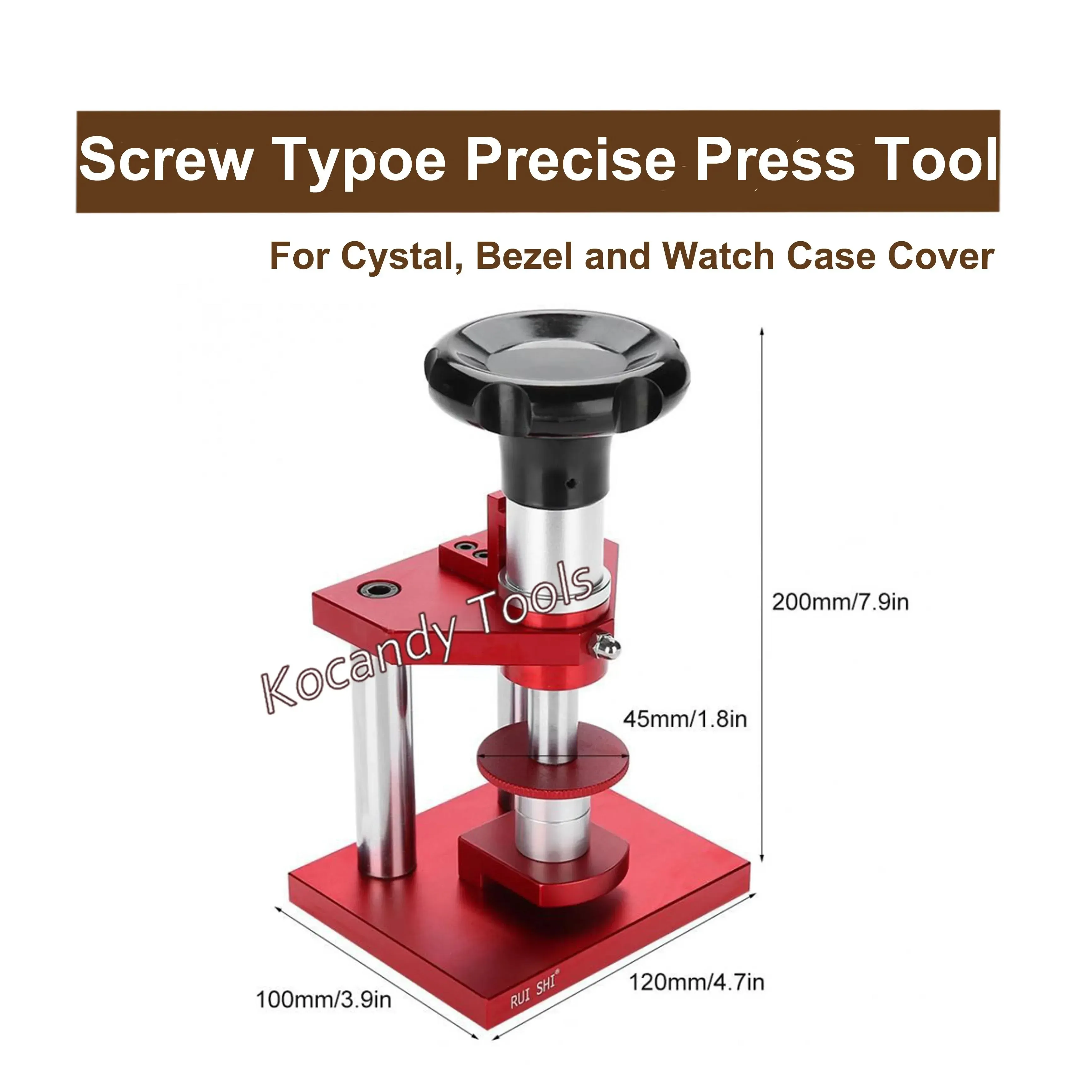
Watch press, screw type | Steel and aluminium; listed for back case and crystal/bezel closing; no die sizes given | |
Acrylic crystal press dies, 5-piece | Acrylic; 5 dies plus a storage box; diameters listed as 59 / 54 / 49 / 44 / 39 mm | |
Case closer and crystal fitting die set, 12 pieces | 12 pieces; one peltate die at approx. 46 mm; round dies at approx. 20/26 mm | |
Aluminium alloy and nylon capping dies, 20-size set | Aluminium alloy and nylon; dies listed as 20 pcs, 20 mm - 58 mm | |
Screw-type back case cover press tool, 20 dies | Stainless steel and aluminium; dies listed at 20 25 30 35 40 45 mm; round sizes 18/20, 21/23, 24/26, 28/30, 31/32, 33/34, 36/38, 40/42, 43/45, 48/50; plus 2 round dies at 16/16 and 20/25 mm |
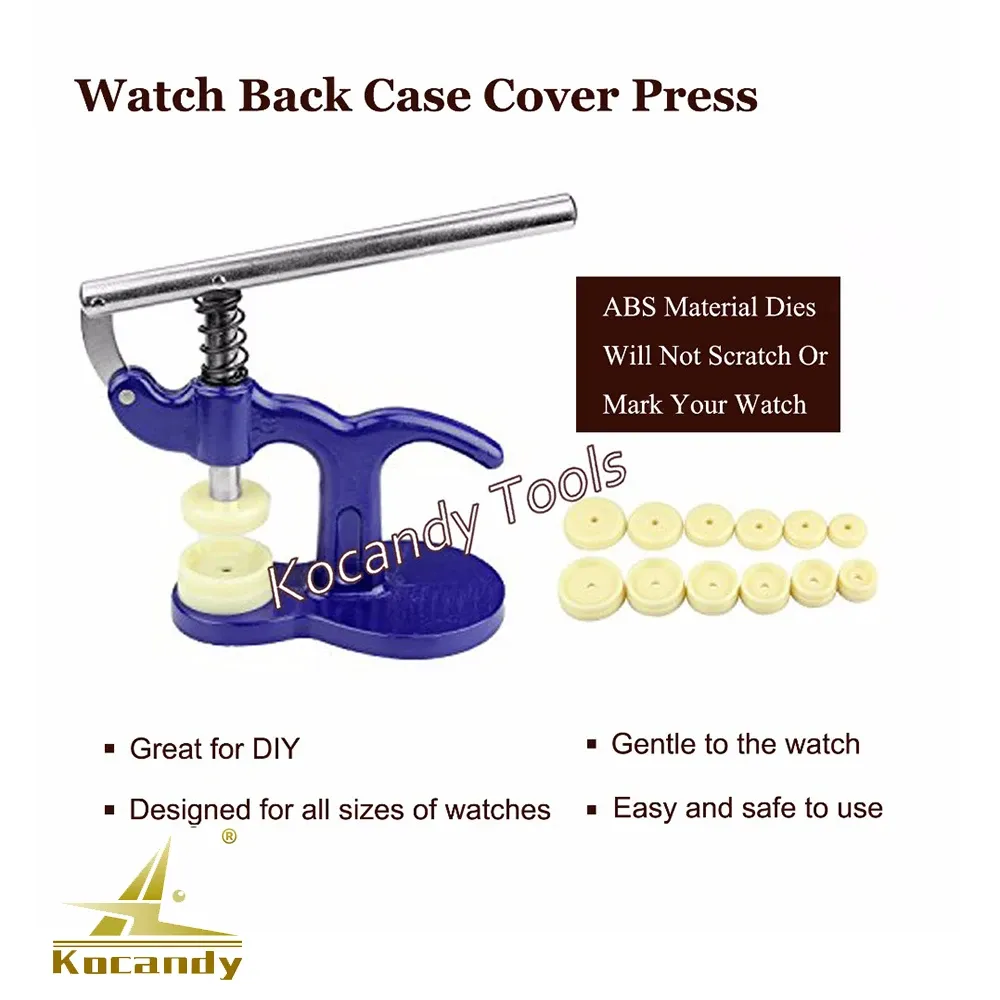
Two are screw-type by name; one is listed with a lever handle in its image; the rest are die sets whose listings do not state a mechanism.
Case backs and crystals are different jobs
A case back is rigid and usually flat in the middle, so the die only presses the seating ring and the load can be fairly direct.
A crystal is brittle, often domed, and may be held by a tension ring or bezel rather than the case. The die has to spread load evenly, which is why soft acrylic or nylon dies are used for crystal work; our acrylic crystal press dies are listed for watch face glass pressing, and the nylon and aluminium capping dies for cover capping. A crystal die locates by its bore over the crystal edge: press the centre of the glass and it cracks.
Never assume the die that seats your backs is the die for the glass. Check which ring each die sits on, and if the listing does not say, ask.
If your size isn't in the chart
Die sets stop somewhere. The sets here run from a listed 15-17 mm up to 20 mm - 58 mm depending on the item, and none lists every size in between. If your measurement falls in a gap, or your case is metric and the nearest die is imperial, do not press and hope.
What to send:
- The bore you measured, in millimetres.
- The case or watch model, if you have it.
- The part number for the back, crystal or tension ring, if it is stamped.
With those three we can match the die before you buy. The listing says what a die is for; the final call on your case is ours.
Send the model, the measurement or the part number
Do not guess your size and order around the guess. Measure, then send it.
Send the model, the measurement or the part number and we will match it against the dies we list and reply within one working day. Between two dies? Say so.
FAQ
How do I measure for a case press die?
Take the case off the movement, lay it flat, and measure across the flat seating ring that the back lands on, in millimetres. For a crystal, measure the opening instead.
What do the two numbers on a die mean?
The first is the bore, the opening that sits over the rim you press. The second is the die body, which must clear the case, lugs and bezel. A die written 18/20 has an 18 mm bore in a 20 mm body.
Can I use a case back die to press a crystal?
Two listings here are sold for both back case and crystal work, so it depends on the die, not the press. Crystal work usually wants a softer acrylic or nylon die with a bore that locates on the crystal edge.
My size is between two dies. What now?
Do not press the nearer one and assume. Send both numbers and the case model and ask which die the chart points to. Too large a die bears on the case edge; too small loads the centre.
Do these sizes fit my watch?
No listing here states that a die fits a named watch. Each is listed for a bore or a size range; the final check on your case is what we do when you send the measurement.